

How to Inspect RV Seals and Roof Before Spring Storage in Boerne
How to Inspect RV Seals and Roof Before Spring Storage in Boerne
Habib Ahsan
May 11th, 2026
The Pre-Season Inspection Most Boerne RV Owners Skip — and Regret
A proper RV seal and roof inspection before spring storage is the single most cost-effective maintenance task in the Hill Country RV ownership calendar — and the one that gets skipped most reliably. Families across Boerne, Bulverde, Spring Branch, and Fair Oaks Ranch pull their RVs out of winter storage each spring, ready to load up and go, and many of them discover the consequences of a missed fall or spring inspection only when water has already found its way inside.
The Boerne area climate is not kind to RV seals and roof membranes. The combination of intense UV exposure through spring and summer, significant temperature swings between seasons, and periodic hail makes the exterior of a stored RV work harder than most owners account for. A roof that looked fine in October may have dried, cracked sealant, and compromised membrane adhesion by March. The gap between those two states is where water intrusion begins — quietly, invisibly, until the ceiling is soft and the subfloor has already started to delaminate.
Why RV Roofs and Seals Degrade During Storage in South Texas
The degradation that happens to RV roofs and seals during storage is not random — it follows predictable patterns driven by the same environmental factors that affect every vehicle stored in the Hill Country. Understanding what causes the damage makes the inspection process more purposeful and the findings easier to interpret. Rubber roofing membrane — the most common material on RVs manufactured in the past two decades — is vulnerable to UV oxidation over time. Prolonged sun exposure dries the membrane, reduces its flexibility, and causes the surface to become porous. A membrane in this condition is more susceptible to puncture, tearing at seams, and separation from the decking below it. The process is gradual and invisible until water has found the resulting gap.
Sealant around roof penetrations — vents, air conditioning units, skylights, antennas, and plumbing stacks — is equally vulnerable. Most RV sealants are formulated to remain flexible across a wide temperature range, but the Texas Hill Country temperature differential between summer highs and winter lows is at the end of what most sealants are designed to handle year after year. Eventually, the sealant pulls away from the surface, develops cracks, or hardens to the point where it no longer performs its intended function.
How to Inspect the RV Roof Before Spring Storage
What You Are Looking For
A spring roof inspection does not require specialized tools or professional training. It requires a careful visual and tactile assessment of every surface, seam, and penetration point on the roof. Here is what to look for:
- Membrane condition — look for visible cracks, bubbling, discoloration, or areas where the membrane appears to have separated from the decking below; press gently on these areas to check for softness that indicates moisture is already present
- Seam integrity — run your fingers along every seam on the roof surface; seams that feel raised, separated, or brittle have lost their bond and require attention before the vehicle goes into service
- Penetration sealant — inspect the sealant ring around every item that penetrates the roof; any sealant that is cracked, pulled back from the surface, or has hardened visibly needs to be removed and replaced
- Drainage points — clear any debris from roof drainage channels and check that water has a clear path off the roof in all directions; standing water accelerates membrane degradation significantly
- Physical damage — look for any punctures, tears, or impact marks that may have occurred during the storage period; even small punctures allow water infiltration under the right conditions
The Roof Access Question
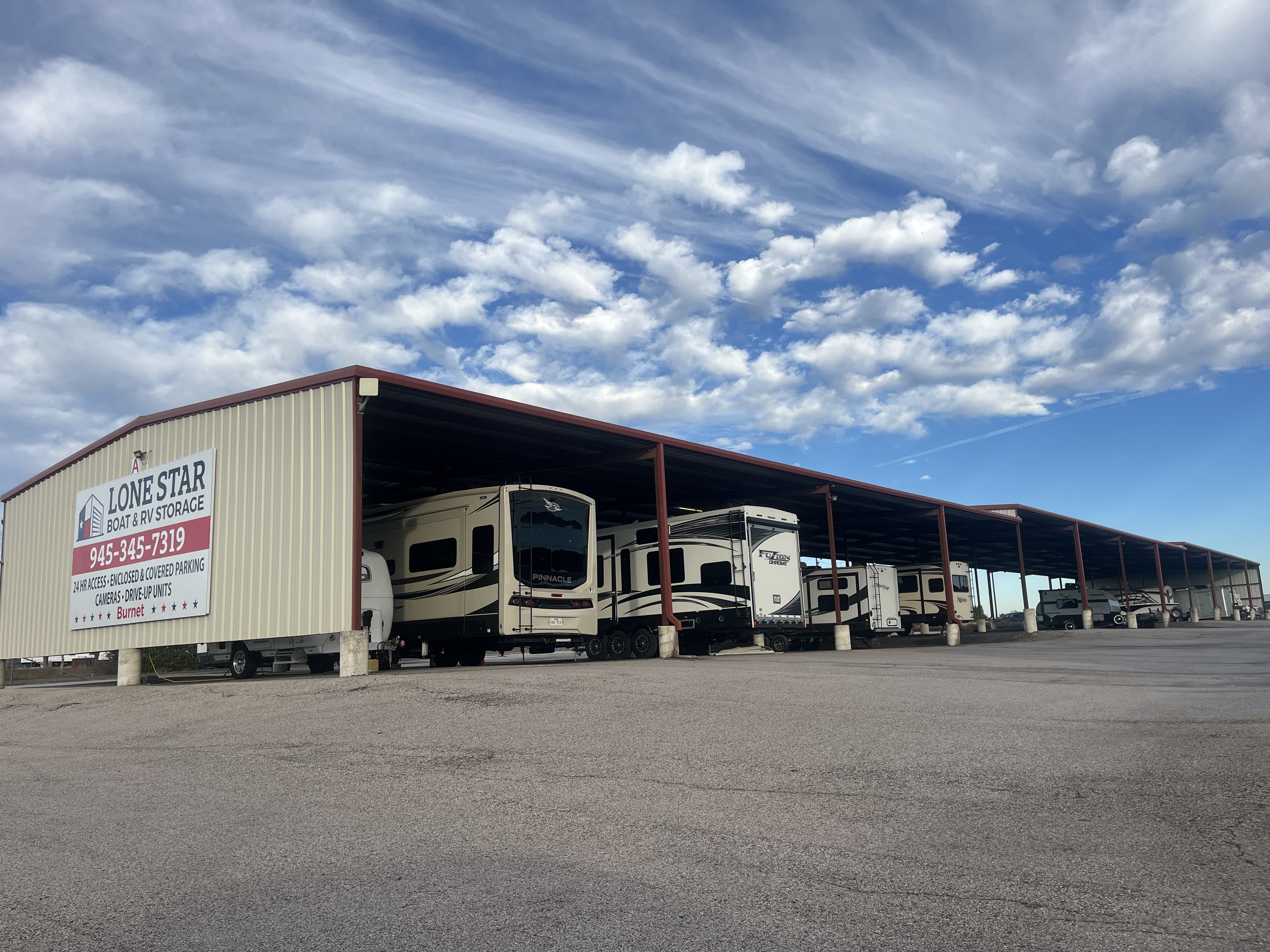
Inspecting an RV roof properly requires getting on it, which means the inspection is most practically done at a storage facility with drive-up unit access rather than at a residential driveway where roof access is more awkward. At Lone Star Boat and RV Storage on TX-46 in Boerne, drive-up units and wide paved driveways make the process straightforward. Park the vehicle, set up a stable ladder at the rear corner of the rig, and work systematically from front to back and side to side.
How to Inspect RV Seals Before Spring Storage
RV seal inspection covers a broader surface area than the roof alone. The exterior of an RV has dozens of sealed joints, frames, and penetration points that are all subject to the same UV and temperature stress as the roof. A complete pre-spring seal inspection covers all of them.
Exterior Sealant Points to Check
Work around the full perimeter of the vehicle at ground level, checking every sealed joint and frame. The priority areas include:
- Slide-out gaskets and seals — the rubber gaskets around slide-outs compress and extend repeatedly with every use and are among the first seals to show wear; look for cracking, tearing, or areas where the gasket no longer makes full contact with the exterior wall
- Window and door frame sealant — check the sealant bead around every window frame and exterior door; pay particular attention to the corners where two sealant runs meet, as these are where failures most commonly originate
- Compartment door frames — storage compartment doors are often overlooked; inspect the sealant around each frame and the weatherstripping on the door itself
- Front and rear cap seams — the front and rear caps of most RVs are bonded to the sidewalls with sealant that is under constant stress from the flex of the vehicle in transit; these seams are high-priority inspection points
- Roof-to-sidewall seam — the joint where the roof membrane meets the sidewall is one of the most critical seal points on the entire vehicle; run your hand along the full length of this seam on both sides and inspect it visually for any separation or sealant failure
- Awning hardware mounts — the mounting brackets for slide-out awnings carry a significant load during use, and the sealant at each mount point is worth inspecting before the first deployment of the season
What to Do When You Find a Problem
Finding a failed seal or compromised roof section is a better outcome than driving a season on a compromised vehicle and discovering water damage in the fall. The repair process for most sealant failures is straightforward and within the capability of most owners who are comfortable with basic maintenance tasks. For sealant replacement, the most important step is removing the old sealant completely before applying new material. Applying new sealant over degraded old sealant creates a temporary cosmetic fix rather than a lasting repair. Use a plastic scraper to remove the old material, clean the surface with an appropriate solvent, and apply a compatible self-leveling sealant for horizontal surfaces or a non-sag sealant for vertical applications. Check compatibility with your specific roof membrane type before purchasing — the wrong sealant chemistry can damage certain rubber roof materials.
For roof membrane issues beyond surface sealant, consulting a qualified RV technician before the season starts is the right call. Water damage from an unaddressed membrane failure is significantly more expensive to repair than the membrane service itself.
Storage Environment Affects How Often You Need to Inspect
The frequency and severity of seal and roof degradation are directly related to how much UV and weather exposure the vehicle receives during storage. An RV stored in an open lot in Boerne through the spring and summer accumulates more UV stress and hail risk than one stored in a covered or enclosed unit during the same period. The inspection findings for an open-lot-stored vehicle in spring are typically more significant than for one that has been protected from direct exposure.
Covered and enclosed storage options at Lone Star Boat and RV Storage reduce the rate of seal and roof degradation between seasons — meaning less repair work at each inspection and lower maintenance costs over the life of the vehicle. New tenants receive 50% off their second and third months. Reserve your covered or enclosed unit on the Boerne RV storage reservations page. To compare all three Hill Country locations, visit the Lone Star RV and boat storage page. Questions about covered and enclosed unit availability? Reach the team through the contact page — a local person will get back to you.
Categories