

How Texas UV and Heat Destroy Your RV Roof — And How Covered Storage Stops It
How Texas UV and Heat Destroy Your RV Roof — And How Covered Storage Stops It
Habib Ahsan
June 2nd, 2026
The Roof Problem Most Texas RV Owners Discover Too Late
Texas UV and heat damage to RV roofs is one of the most expensive and most preventable maintenance issues in Hill Country RV ownership — and it is almost always discovered at the worst possible moment. An owner in Liberty Hill, Georgetown, or Cedar Park pulls the RV out of storage after a season, climbs up to do a quick look before a road trip, and finds a membrane that is chalky, cracked, and pulling away from the edges. Or worse, they find it by noticing a soft spot on the ceiling inside.
The damage did not happen overnight. It accumulated quietly across every day the vehicle sat under direct sunlight, and it was entirely preventable with covered storage. Understanding how UV and heat destroy an RV roof makes the case for covered storage in Central Texas more clearly than any monthly rate comparison.
How UV Radiation Breaks Down RV Roofing Materials
Most RVs built in the past two decades use one of three roof membrane materials — rubber (EPDM), thermoplastic polyolefin (TPO), or fiberglass. All three are vulnerable to ultraviolet radiation, but they degrade in different ways and at different rates. What they share is a common outcome: prolonged UV exposure without protection shortens the functional lifespan of the roof significantly.
EPDM Rubber Roofs
EPDM — the black or white rubber membrane found on the majority of travel trailers, fifth wheels, and entry-level motorhomes — degrades under UV exposure through a process called oxidation. The membrane surface develops a chalky residue, loses flexibility, and becomes porous over time. A porous EPDM membrane no longer sheds water effectively at seams and penetration points — it absorbs it. That absorbed moisture works its way under the membrane and into the wood decking below, where it causes delamination, rot, and mold that spreads before any exterior sign is visible.
In the Liberty Hill and broader Hill Country climate, EPDM roofs on open-lot-stored RVs show measurable oxidation within one to two storage seasons. By season three or four, the membrane has lost enough flexibility that normal thermal cycling — the expansion and contraction from day-to-night temperature changes — begins to open micro-cracks at seams that no sealant application can fully address without a full membrane replacement.
TPO and Fiberglass Roofs
TPO membranes are more UV-resistant than EPDM but are not immune. Prolonged direct sun exposure causes TPO to lose plasticizer content over time — the chemical component that keeps the membrane flexible. A TPO roof that has lost significant plasticizer becomes brittle and prone to cracking under the stress of foot traffic, hail impact, or thermal cycling. Fiberglass roofs are the most durable of the three, but still experience gel coat oxidation and surface degradation under sustained UV exposure that leaves them vulnerable to water intrusion at penetration points.
The Texas Heat Amplifier — Why Central Texas Is Especially Damaging
UV intensity alone does not tell the full story of RV roof damage in the Liberty Hill, Jarrell, and Georgetown area. Heat amplifies UV damage through a process called thermal cycling — the repeated expansion and contraction of roofing materials as temperatures rise and fall between day and night.
In Central Texas, an RV roof surface under direct summer sun can reach temperatures significantly above ambient air temperature. The membrane expands under that heat and contracts as temperatures drop overnight. That expansion and contraction cycle stresses every seam, every lap joint, and every point where sealant meets membrane — repeatedly, across every day of the storage season. Sealant that was flexible when applied becomes brittle under this cycling and eventually pulls away from the surfaces it was bonded to.
The combination of UV oxidation weakening the membrane and thermal cycling stressing the seams creates compounding damage that accelerates with each season of open-lot storage in the Texas climate.
What Covered Storage Actually Prevents
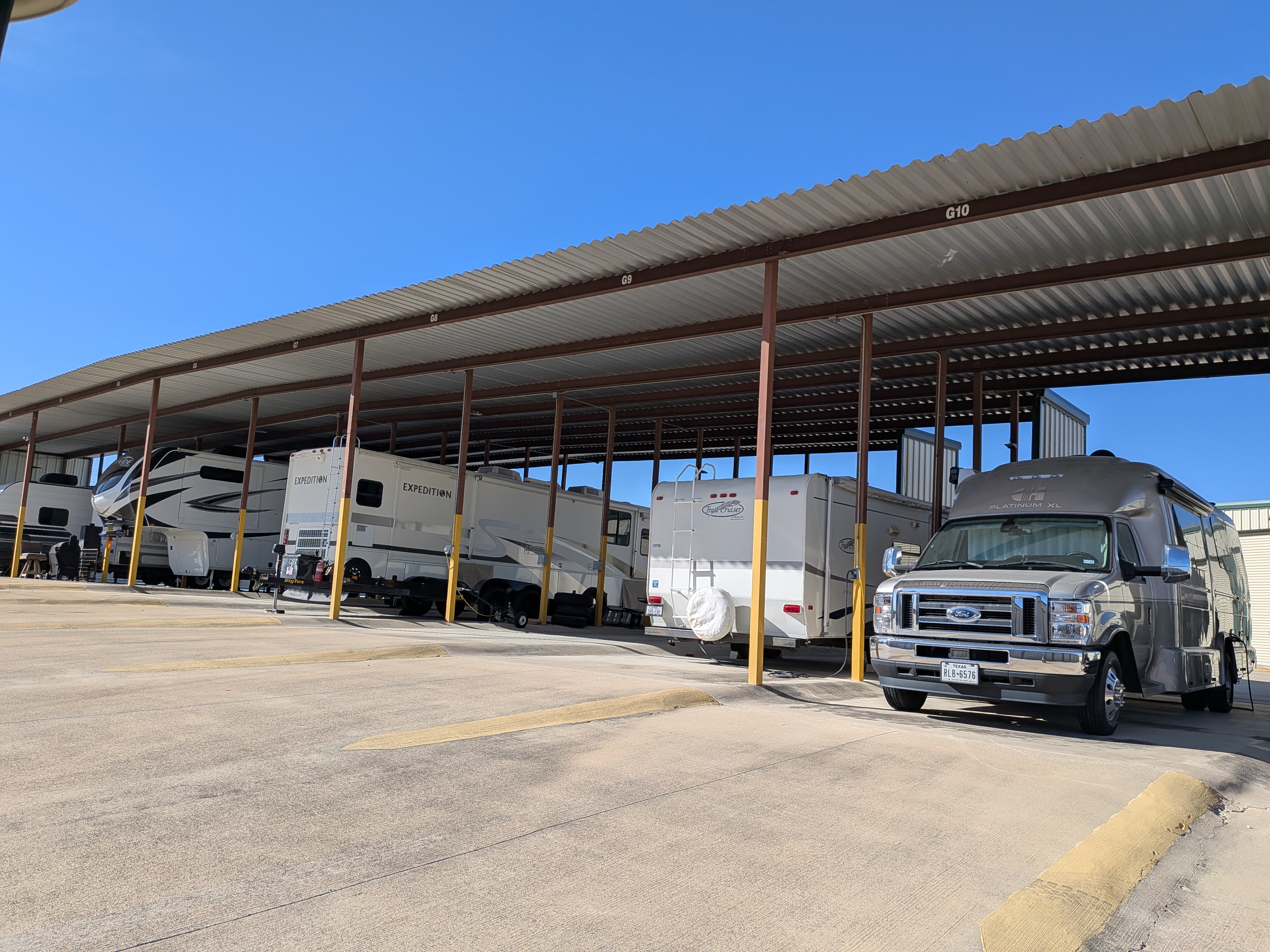
Covered storage places a permanent roof structure between the RV and the sky. That single intervention addresses the two primary drivers of RV roof damage in the Central Texas climate:
- Direct UV radiation on the membrane surface is eliminated — the membrane retains its flexibility and integrity significantly longer without sustained UV exposure
- Peak surface temperatures are dramatically reduced — a roof membrane in shade does not experience the extreme temperature highs that drive thermal cycling stress on seams and sealant
- Hail impact risk is removed entirely — a roof already weakened by UV exposure is particularly vulnerable to hail damage; covered storage eliminates that risk
- Rain accumulation on compromised seams is reduced — a covered unit shields the roof from direct rainfall that would exploit any early-stage sealant failure
Enclosed storage extends this protection further — removing lateral UV exposure on sidewalls and windows, moderating interior temperature swings, and providing full weather protection from all directions. For owners of higher-value coaches or vehicles with known roof sealant that is approaching the end of its service life, enclosed storage buys meaningful additional time before the next maintenance cycle.
The Cost Comparison That Makes Covered Storage the Clear Choice
The financial case for covered RV storage in the Liberty Hill area is straightforward when the numbers are laid out honestly. A rubber roof replacement on a midsize travel trailer or fifth wheel runs between one thousand five hundred and four thousand dollars, depending on size and membrane type — and that does not include the cost of repairing any water damage to the decking, ceiling, or interior that preceded the roof failure.
A covered storage unit at a modest monthly premium over open lot storage costs a fraction of that over a full season. For most RV owners storing in the Liberty Hill, Cedar Park, Leander, and Georgetown market, the premium for covered storage pays for itself within a single season when measured against the maintenance costs it prevents — and it continues paying forward for every season the vehicle remains in covered storage.
Getting Your RV Into Covered Storage at Liberty Hill
Lone Star Boat and RV Storage on State Highway 29 offers covered and enclosed storage options for RV owners across Liberty Hill, Georgetown, Leander, Cedar Park, Andice, Jarrell, and Burnet. Spaces accommodate vehicles up to 50 feet. Wide drive aisles, paved surfaces, 24/7 keyless gate access, and a free air compressor on-site make the facility practical for owners who use their RV regularly through the season and need storage that fits their schedule.
New tenants receive 50% off their second and third months. Reserve your covered or enclosed unit on the Liberty Hill covered RV storage reservations page. To compare all three Hill Country locations, visit the Lone Star RV and boat storage page. Questions about covered unit availability or sizing? Reach the team through the contact page — a local person will get back to you.
Categories